
Vapor Talks #5: hofuku sochi 報復措置
An in-depth conversation with Stachy.DJ, a true vaporwave connoisseur and preserver of obsolete recording formats
An aspect that keeps fascinating me about vaporwave is that people find access to it at very different stages of their life. As a decentralized internet genre, it’s not bound to a specific local scene or age cohort: Zoomers, Millennials and even middle-aged Gen X’ers – like myself – seem equally fascinated by these artsy takes on nostalgia, consumerism and a future that never happened.
Polish-born, Germany-based Stachy.DJ (memories of the future) has been involved in experimental electronic music for three decades. Starting out in the 1990s as a drummer for alternative hip-hop group Fischmob (which also included a young DJ Koze), he shaped Berlin’s techno and house scene as a producer and engineer, then relocated to Dresden and, by the mid-2010s, discovered vaporwave. Cultivating a love for analog equipment, obscure samples and obsolete formats like Sony’s MiniDisc, he’s released vaporwave experiments under the moniker hofuku sochi 報復措置.
For Vapor Talks, we spoke about Stachy’s long-standing career beyond the mainstream and the lasting influence of vaporwave on his artistic practice. A story about sliced sausage, MiniDisc DJing and underwater soundsystems – and the inherent danger of always being one step ahead of the pack.
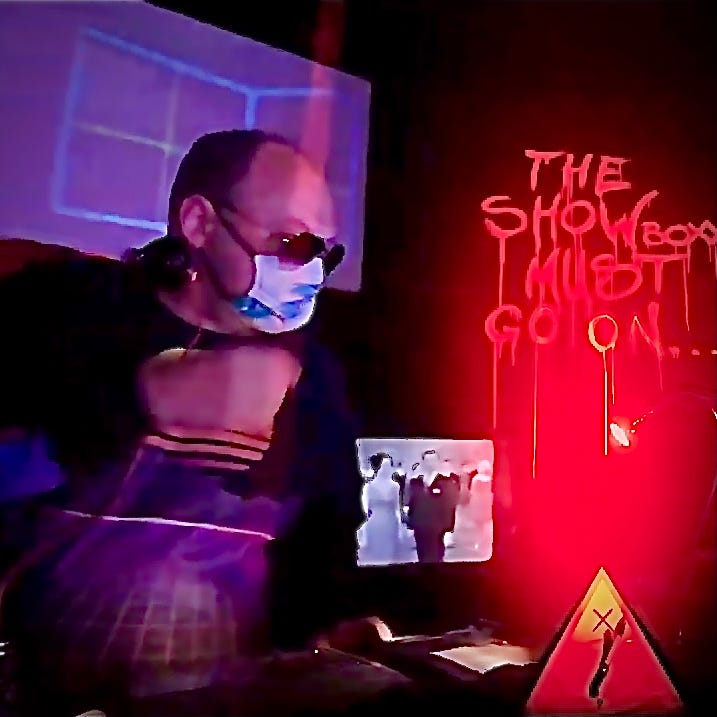
You were actually born in Poland, right?
That’s right, I spent my childhood in Gdańsk, Poland. I fled when I was 16, in 1989, shortly before everything collapsed. My parents are both classical musicians and stayed in Hanover while touring what was then West Germany. I stayed in Poland on my own and fully immersed myself in the alternative scene – punk, [new] wave and so on. In the years before that, I went to music school, every afternoon after regular school. My first instrument was the drums. I was already active in a punk band at the time. We had a rehearsal room in a kindergarten. There was a lively underground scene with more or less official concerts.
At the age of 16, you ended up in West Germany, in the city of Flensburg to be precise.
Yes. When I came to the West, I shaved off my mohawk and completely gave up my punk lifestyle within a few weeks after seeing that you could buy sliced sausage here, shrink-wrapped in colorful packaging. Capitalism was a culture shock for me, and as a result, my musical activities remained on hold until about 1992. That was after the German reunification. Flensburg needed space, and we were neither asylum seekers nor recognized refugees, but lived on the basis of temporary residence permits, so my family – except for me – was deported.
I stayed, fought back and successfully sued the city and the immigration office. That’s when I started coming into contact with lots of people and realized that Flensburg was pretty buzzing. There were lots of bands and rehearsal rooms. Gradually, I joined various bands. I was in seven bands at the same time, ranging from death metal to fake jazz, and I was also part of a very unfortunate German rock band for a while. I just wanted to play. Do you still remember the band Flugschädel?
Yes. I grew up in Northern Germany in the early 1990s, and I actually bought both the Flugschädel album and the first Fischmob album.
John Peel even played Flugschädel once in his show. I saw them live in a local venue, Volxbad, which still exists. After that performance, I was totally intoxicated by it; it was really something else. Then one day Eule [of Flugschädel] came by my place. I was living in relatively spartan conditions, in an abandoned house in the middle of the city. The rent was 150 Deutschmarks [around $150 as of today]. In one room, I had a drum kit, so I just sat down and played for a bit. Eule said he knew a couple of guys who were looking for a drummer, but they were in Hamburg. Funnily enough, I went to the same high school as Koze and Cosmic [of Fischmob], but they’d been a grade or two above me and we hadn’t noticed each other at all. I was just about to graduate and faced with the decision of whether to get my degree or go to Hamburg. I decided on Hamburg and joined [Fischmob] straight away.
Did you have any previous contact with hip-hop at all?
Yes, I was aware of [German rap pioneers] Advanced Chemistry. After [the 1992 racist attacks in] Rostock-Lichtenhagen, that was a big topic in the squatter scene, where I was hanging out. Bands like Public Enemy and Disposable Heroes Of HipHoprisy were also prevalent. There were lots of crossover bands1 in Hamburg and Bremen, I can’t even remember their names. Hip-hop was never really the main focus or an end in itself, but it was playing constantly in the background.
Fischmob existed from 1993 to 1998, releasing two really successful albums. You came from the far left and the squat scene though. How connected did you feel to the more traditional hip-hop scene?
That’s a difficult question. I never felt like I was purely a hip-hop artist. We were in contact with the whole Hamburg posse, i.e. [German hip-hop groups] Fünf Sterne Deluxe, Fettes Brot, Absolute Beginner and so on, but the time with Fischmob was so intense, we were so busy with all the touring. We did two or three big tours, and then we were also on the road with [local pop-punk superstars] Die Ärzte. It was never particularly important to me whether what we were doing was hip-hop. Koze and I also DJed a lot, playing “gay” house music at the time, and that was sometimes hard for the hip-hop guys to understand. We were very open-minded, which also complicated things because we didn’t fit into the classic hip-hop mold. We were kind of stylistic outsiders, so to say.
Your first release as Hofuku Sochi – the alias under which you later released your vaporwave music – was the 1999 instrumental EP Denshi.
Exactly, I was already working on my Japanophile stuff alongside Fischmob, back then with a musician friend. It was just about having fun, experimenting with equipment, somewhere between musique concrète, radio plays, pop and electronica. Multitrack technology was still in its infancy back then. We had no idea about MIDI and weren’t interested in it either. It was a completely natural process. We just went for it.
Someone once said to me that it was actually proto-vaporwave in its approach. I didn’t realize that. I’m more the type of person who just makes music and sees what comes out of it, rather than thinking too much about the theory behind it.
Where did this Japanophile approach come from?
I’ve always been interested in Japanese aesthetics, art and music, so it felt obvious to me. With Fischmob, our songs always dealt with specific topics – each track had a title that also determined what the lyrics were about. I wanted to shake that off and free myself from it. I wanted people to be able to interpret whatever they wanted into it, or even make the effort to decipher these kanji.
In the 2000s, you worked on various projects in the minimal techno and electronica genres, and with No Accident In Paradise, you had an early ambient project, well before the so-called ambient boom. You were a little ahead of your time.
Yes, I always have that urge to be at the forefront. That’s simply because everything that happens within conventions quickly becomes boring for me. It probably comes from my inner playfulness – anything that already existed has always been uninteresting to me. I’ve usually tried to extract the essence of what I’ve done before and combine it into something new. It’s a bit of a curse. I’ve often done things that people really invested in a few years later, because suddenly lots of people were doing the same or similar things. On the other hand, I sometimes lack staying power. I’m already on to the next thing.
Even back when I was still living in Flensburg, I used to put together these psychedelic audio play tapes – if I showed them to you now, you’d probably think, “Okay, that’s kind of like proto-vaporwave.” For me, there’s a larger connection, but of course I didn’t really realize that until much later.
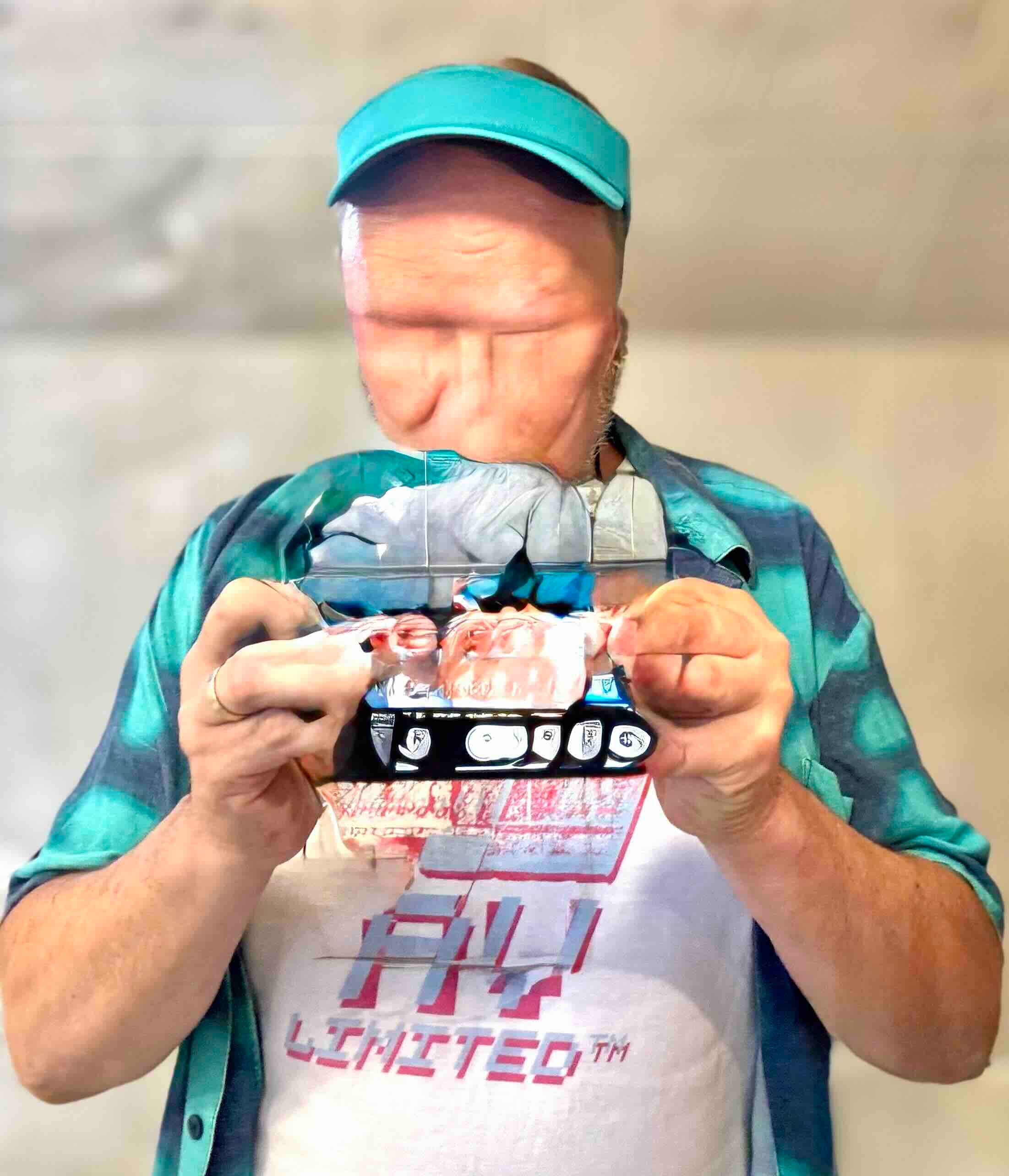
When did you first hear about the genre of vaporwave?
Relatively late – in early 2016, I heard a show on Red Light Radio where a guy was mumbling in very bad English, and he was playing a whole show of Dream Catalogue stuff. I was already over 40 at that point, and I thought nothing in my life would ever excite me as much as “Fremd im eigenen Land”2 did back then, or later on, the house music at [legendary Hamburg nightclub] Golden Pudel.
Today, I actually understand why vaporwave triggered me so much. It’s a playful way of looking at memory and recollection. When I play vaporwave out as a DJ, even older people than myself come up to the booth and ask, “What is this? I know this!” And I usually reply, “Yes, but it’s not what you think it is.” It was precisely this irritation that sparked my interest back then. It was truly magical.
In the scene, you’ll find lots of Zoomers and Millennials, but some Gen X’ers like us as well. We feel this nostalgia very directly, while younger people might feel a longing for a time they never experienced.
But for them, it’s not immediate, and that’s what’s so fascinating. They didn’t grow up on the music, they didn’t consciously experience it. They don’t even know the samples – they just like the songs, but they found them by chance on YouTube. I think the kids back then, in the early days of vaporwave, didn’t have a connection to the music at all – they just discovered something and realized that it worked, or that it could be quickly turned into something that appealed to others. Whereas we experienced this music directly as kids back then, so we can remember it specifically.
Did you start experimenting with this style relatively soon after stumbling across that radioshow?
Well, I’m an old-school musician and I grew up with a different concept of copyright, where you always had to ask yourself whether you were actually allowed to sample something. Vaporwave completely turned this classic copyright thinking on its head, and I’m glad that I managed to make this shift – to not see it as a threat and free myself from this thinking. Because sampling is usually not about riding on the coattails of another artist’s success. It’s about using the sample as a language, a code for something else. These thought processes started very quickly for me, and I think it was the right time because I was so fed up with everything. I thought I had already seen, heard and experienced everything, like “Okay, now you’re going to lose your hair, get fat, have kids, maybe a second car in the garage.” And then vaporwave came along. It actually triggered a new impulse in me.
It just completely baffled me. I didn’t know what to make of it. It was like black magic. So I really approached this subject thoroughly, from a music journalism perspective. First, I wanted to get some information: Where did it come from? What is it? So I started reading up on it. I got hold of a scientific treatise on vaporwave by Ekko Iruka [Vaporwave – A Dystopian Musical Codex], which contained the most important artists, their discographies, the terminology, the connection to the queer scene, etc. Then I quickly realized that it wasn’t just a musical phenomenon. I was interested in this use of waste, which is a kind of recycling, the inherent critique of consumerism, everything that kids today don’t know about, but which stood at the beginning of vaporwave. Well, I don’t expect anyone else to know about it. In any case, I know why I’m interested in it.
Once I had finished this theoretical part, I started making tracks and achieved quite a lot relatively quickly. And then I was done with it again after two or three years. For me, it was just part of my artistic education. Technically, everything I had learned was turned upside down. All conventions were broken. I wanted to use that as the essence for my future work. Vaporwave gave me new ideas. I tried to apply the aesthetics and production techniques to other areas, such as mastering and engineering.
Did you seek connection with the vaporwave community?
No, I wasn’t necessarily looking to network. I’m a terrible networker anyway. I’m just such a damn egoist who only does things for himself. Sure, of course I do it for the people as well, for the audience. As an artist, you want feedback from the audience, but at that moment I didn’t want to go down the same path again, looking for like-minded people and so on. What I found on the internet was enough for me. It was enough to motivate me to continue exploring it.
Since 2017, you’ve released vaporwave-inspired projects under the name hofuku sochi 報復措置. By that time, that was your solo project, right?
Yes. The partner I had been working with for years was gone, and I decided to continue Hofuku Sochi on my own. It should be noted that this is a very ugly word in Japanese, meaning something like “massive retaliation,” and in Japan it is associated with the atomic bomb. I chose the name deliberately at the time, as a contrast. When I reactivated the project in 2016, I didn’t want to have another artist pseudonym, I just wanted to continue under the same name. But I had it translated into kanji again, and added those Japanese characters to the name.
Vaporwave often deals with technologically obsolete formats such as CDs and tapes. You take it to the extreme with MiniDisc, a Sony-controlled format that was discontinued in 2011. At Slushwave 2025, you even played an entire MD set. What’s the appeal?
With MiniDisc, it’s actually nostalgia. Unlike cassettes, they really disappeared from my life at some point and then reappeared in a new quality. I’m a big fan of the French label Underwater Computing and have many MiniDiscs from them – they’re little gems, both in terms of their graphic design and the music. I also have a MiniDisc release on my Bandcamp that deals with Canadian minimal electronica from the era of netlabels.3
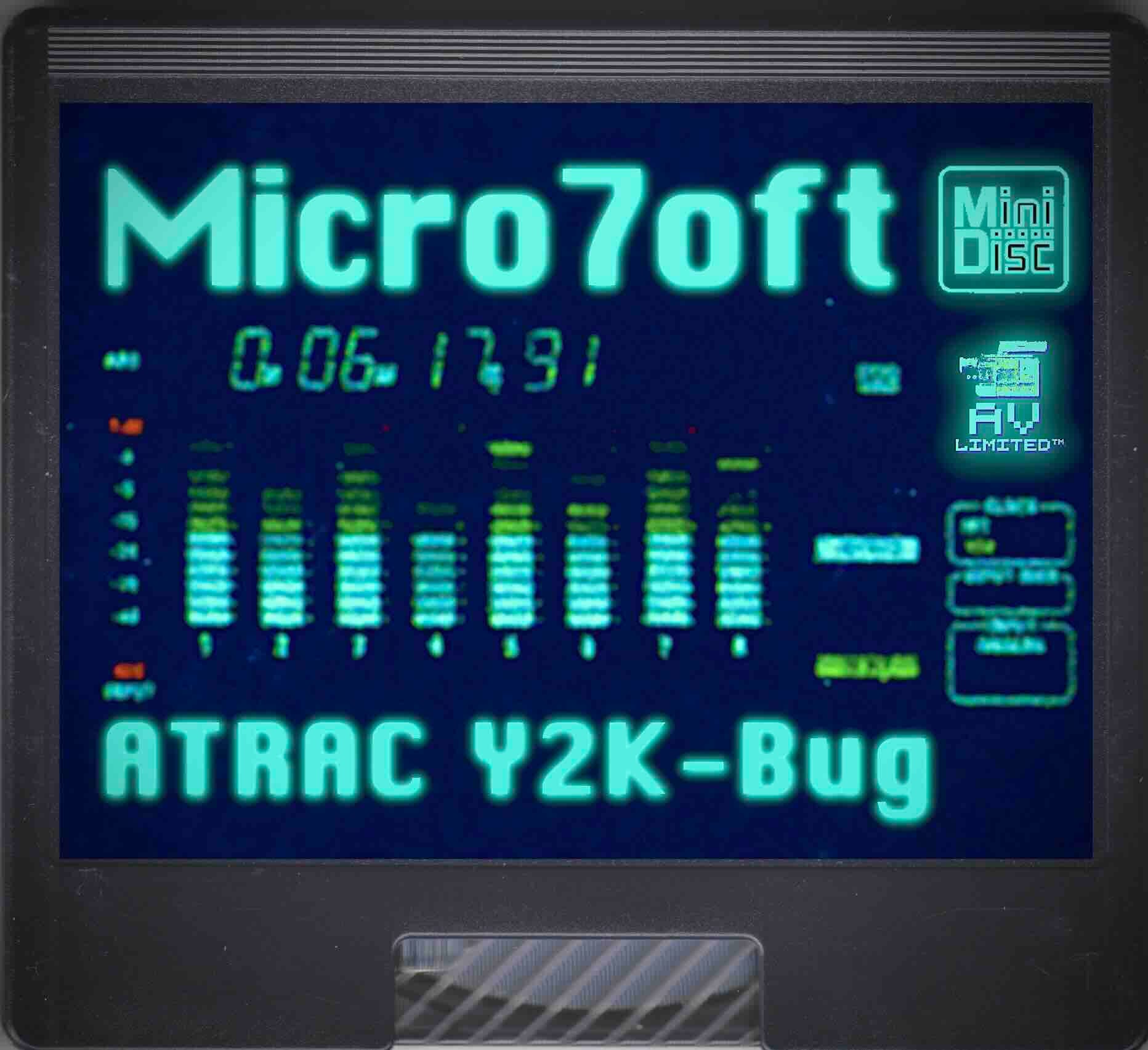
Just for fun, I bought two MiniDisc DJ players with jog wheels. There’s only one model in the world, made by Sony in 1998, and I have two of them. I spent two years searching for them. They were extremely expensive. I found one in Japan and the other in Italy. Now this is actually “vaporware”! A lot was promised back then – the bright future of haptic media. After a decade, it failed miserably, thanks to MP3. Shoutout to the Fraunhofer Institute.4 [laughs]
Cassette tapes have never ceased to exist for me though. I have a fairly large collection that has always been with me, just like my 6,000 records, so I can’t even speak of nostalgia in this regard. That format is quite normal for me. With MiniDiscs, however, Sony had a monopoly – they owned the only pressing plant in Europe for MiniDiscs. Original MiniDiscs are now a good investment. I recently saw [Daft Punk’s] Homework for €666, the original edition. I don’t have enough money to pay such prices, but I do collect MiniDiscs. I hunt for bargains; that’s my hobby.
There is now a huge amount of vaporwave out there, and much of it is cobbled together rather carelessly. How do you see the development of quality in the genre?
I’m glad you asked. My aim has always been to experience this genre in all its facets and subgenres, with the same intensity and quality that I encountered when I first discovered it. But in my perception, there was indeed a bit of a dip at some point. With many releases, it was more about the surface now. There was a glut of inferior stuff, and during the pandemic I listened to and sifted through entire catalogs of labels. I’ve actually completely moved away from digital music. I just listen to tapes, vinyls or MiniDiscs, and that’s what I play out as a DJ.
Coming from electronica and ambient music, would you confirm that vaporwave is possibly just a subgenre of ambient music?
Well, I can’t fully agree with that. The ambient side of vaporwave is only one aspect of what it’s all about. It’s really a holistic art movement that goes far beyond music and was made possible by the internet. On the subject of ambient vaporwave, or dreamtone as the subgenre is often called, it’s perhaps relevant to mention that I host the Liquid Sound Club, an underwater clubbing experience in the thermal baths in Bad Schandau [near Dresden], and this kind of music was perfect for playing it there.
I will say though that in the beginning, I didn’t even recognize much of the genre as vaporwave, but rather as ambient. I immediately incorporated these things into my sets. So my whole approach came via ambient and the ambient side of vaporwave. As a DJ, it was always important to me to slip new stuff in without disturbing people. It just has to fit into the context, and at some point they’ll listen up and say, “Hey, that’s cool. What is it?”
Your artistic practice is quite diverse, could you try to describe what it is exactly that you’re doing today?
I’m actually quite a driven person, but I have to admit that the pandemic was a total blessing for me. It gave me the opportunity to get my thoughts in order and think about what I want and don’t want, what’s important and what’s not.
So I’ve been running a studio here in Dresden since 2008, initially just for myself, quite selfishly. It’s a place full of obsolete equipment, an absolute luxury. All the equipment works, I can read all kinds of data formats, remain format-compatible, so to speak, and have access to it at any moment, whenever the impulse strikes. A technical format only makes sense to me if it can be used immediately – that’s what fundamentally distinguishes me from the nerds who only see it as a ‘retro’ thing.
The studio is my free space, where I often lock myself away. I do mastering and production jobs as well as commissioned work there. I was involved in techno music for a long time and helped shape Berlin techno. I left before it was declared dead, but I stood for this sound for a long time as a producer and engineer. I also do theater and film music in Germany and Poland. Over the years, I’ve accumulated so many ideas and backups that I never really start work from scratch. A lot of it is stuff that’s been around for years, and I just put it in a new context. I have a bit of a foot in the door everywhere, and I’ve managed to keep enough projects running side by side without them colliding with each other.
As I mentioned, in addition to the studio, I have been the host and artist-in-residence at Liquid Sound Club in the thermal baths in Bad Schandau since 2010. They actually have underwater sound systems. The idea wasn’t mine, but I translated it into the context of modern electronic music and managed to establish it there. There are a lot of walk-in customers at the thermal baths, just regular spa guests who often don’t know what to make of it, but now a lot of young people from Dresden and the surrounding area are coming out as well.
At some point, I started working with video for haptic formats too. I have a full video editing suite here in my apartment, basically a complete TV broadcast standard studio from the early 2000s, with all the trimmings. And I’m really lucky that I can somehow make a living from all of this. It sounds totally clichéd to say that you’re “living your dream” – but ultimately, I’m doing exactly what I’ve always wanted to do: be creative.
Listen to hofuku sochi 報復措置 on Bandcamp
Check out Stachy.DJ’s projects on Linktree
Stachy.DJ’s Top 10 Vaporwave Albums
(unranked)
Vektroid – Neo Cali (Prism Corp, 2011)
OSCOB / Digital Sex – Overgrowth (Bludhoney, 2016)
Nmesh & t e l e p a t h テレパシー能力者 – ロストエデンへのパス (Dream Catalogue, 2015)
christtt – 7年后 (self-released, 2013)
Arasmas – Stranger Nights (Coraspect Media Group, 2019)
Diskette Park – Curve Sequences (Private Suite Media, 2020)
Vaperror – Mana Pool (Plus100, 2014)
Blank Banshee – Blank Banshee 1 (self-released, 2013)
shamane – Hyori (Underwater Computing, 2022)
Saturn’s Daughter – Eternal Resonance (Virtual Dream Plaza, 2018)
Differing from the term’s usage in the U.S., in Europe ‘crossover’ was used as a quite specific genre descriptor for 1990s bands mixing influences from hip-hop and alt-rock/metal, like Rage Against The Machine, Body Count or Dog Eat Dog.
“Stranger In My Own Country”, an early iconic track by pioneering German rap group Advanced Chemistry from 1992. With its strong anti-racist message, it became an empowering anthem for the burgeoning German hip-hop scene.
Stachy refers to a scene of decidedly non-commercial online music labels in the 2000s, which had grown out of the DIY tape underground and was most active in the indie, electronic and noise music communities.
The MP3 format was originally developed at Fraunhofer Institute in Erlangen, Germany, starting in 1982. The goal was to compress music digitally so that it could be transferred via ISDN lines.
It reads very smoothly without losing any depth, great interviewee.