
The Old Wave, the New Wave, the Vaporwave
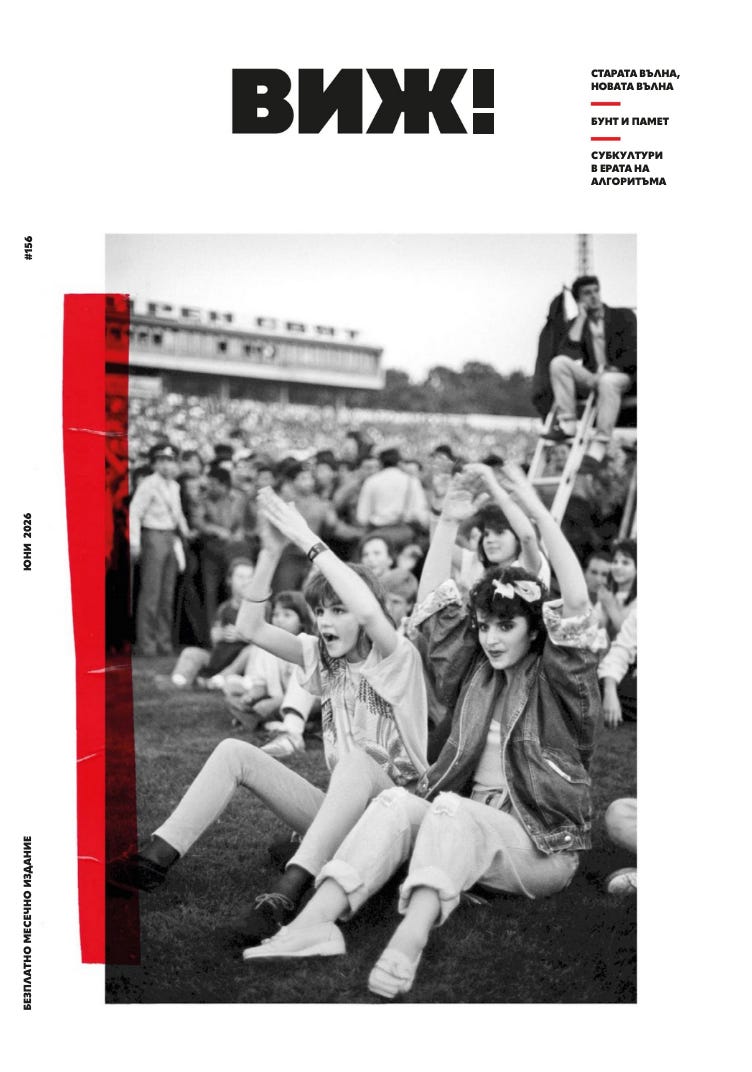
The Bulgarian cultural magazine VIJ published an interview with yours truly

“Then again, what do I know? I’m approaching 50, I listen to vaporwave and I dress like the stereotype of an American trucker.”
Last year, I was invited to participate in a panel discussion on the state of music journalism at a conference in Sofia, Bulgaria. Moderating the panel was the local journalist Svetoslav Todorov. Among many other things, he works as a freelance writer for a Bulgarian culture magazine (print and online) called VIJ mag.
Since he had been commissioned to write an article for their newest issue, which focuses on subcultures and countercultures, he reached out to talk to me about one of my key areas of expertise: vaporwave.
Here’s a direct link to the published article. Yes, it’s in Bulgarian and written in Cyrillic. But you can use a translation tool – and I am also sharing the full original Q&A in English with you below.
Read on if you’re interested in how skateboarding got me into music and subcultures, as well as my thoughts on the development of vaporwave, the gap between online and offline culture, and the state of the punk/DIY ethos.
What was the first scene or subculture you personally felt a part of during your youth, and how did that influence the rest of your life?
Stephan Kunze: I got into skateboarding in the late 80s. The eclectic music I heard in skate videos over the next decade would have a tremendous impact on me, whether it was punk, metal, hip-hop, jazz, rock or electronic music. Interestingly, it was also a skate video edit where I would first discover vaporwave many, many years later!
In my teenage years, I was a smalltown skate kid with goth leanings. I loved discovering different styles of non-mainstream music and I was immersed in 90s “alternative” culture. As I didn’t live in a major city, options were limited in terms of concerts and such.
At some point in the 90s, I got more deeply into hip-hop and electronic music like trip-hop, drum’n’bass and IDM. The underground hip-hop and beat-making scene would become my subcultural home for all of my 20s and into my 30s. At the same time, I developed a huge love for and much knowledge about many other genres just through sample-digging and record collecting.
This influenced my life insofar that I’d dedicate my whole professional and huge parts of my private life to subcultures – I’ve been a music journalist for a quarter of a century now, and I’ve worked across many other functions and jobs in the music, media and tech industry. None of that would have happened without my subcultural background.
Recently, you’ve been writing quite a lot about experimental electronic subgenres from vaporwave to signalwave. Some of these movements draw on a vintage Y2K aesthetic, yet offer something oddly futuristic. What is it about this that you find so interesting?
I’ve been interested in vaporwave since 2013, with varying degrees of intensity. Since the pandemic, the scene has lived through a creative resurgence, mainly because of highly active online communities for subgenres like signalwave or slushwave on platforms like Discord and Bandcamp.
While classic vaporwave was mainly about 80s/90s nostalgia, artists have been diving into more recent cultural phenomena as sources for their works, like the Y2K aesthetic or the Frutiger Aero design language of the 2000s. I think it’s only natural that vaporwave – at its heart a hauntological form of pastiche – will be embracing and exploring new subjects of nostalgia as it evolves. A Gen Z vaporwave producer just doesn’t relate as much to CRT television static or smooth jazz samples; they might have fond memories of YouTube kids documentaries, anime films or early learning software instead, and those will reflect in their inspirations and sample choices.
Signalwave in particular has gradually morphed into a framework for digital collage art that explores the distortions of human memory. I’d even say it’s more of a method or a technique than an actual genre at this point. Historically, it was also called broken transmission and made exclusively from snippets of old radio and TV transmissions. Right now, I feel that you could use any musical genre as source material for signalwave, as long as it serves the purpose of creating an immersive experience that will try to take you to a certain place, evoke a feeling or tell a story.
You’ll find whole signalwave albums dedicated to buildings, landscapes, historical events, films and TV series, or even ultra-specific personal memories like a calm summer vacation in the Hungarian countryside, or a Serbian kid’s experience of the day in March 1999 when NATO started bombing their home. One of my recent favorites is Stuck at Everest Base Camp with a Crappy Little Radio by the producer УВБ-76; he’s American despite writing his name in Cyrillic, by the way.
Would you say that this is more of a digital subculture that cannot be easily transferred to the offline world, or at least not in a recognizable form?
Vaporwave is truly the first decentralized subculture, meaning that it never had a local community in the real world that it grew from. Even the earliest forms of proto-vapor in the years 2010/11 started purely online and digital, in chatrooms and forums. The music was distributed through SoundCloud and Bandcamp. It was made by teenagers from different parts of the US who were bored and lonely in their bedrooms, craving for connection.
It should be noted that there’s a statistic clustering of trans, queer and neurodivergent artists in the vaporwave scene – people who often feel misunderstood and marginalized as outsiders in society, so these anonymous digital communities could feel like safe havens for them to freely express themselves.
It’s correct that this whole idea doesn’t translate as well to offline culture, though there was a push for live events in the second half of the 2010s, with concerts and festivals like 100% ElectronICON starting to take place and even attracting bigger crowds. Those efforts were set back by the pandemic, but in recent years I am seeing a lot happening in this direction again, maybe in a healthier, more local, grassroots-oriented form.
I think that artists and listeners – which often overlap in this culture – will naturally want to find places where they can meet IRL instead of URL, to experience the music together but also just to connect as humans. Due to the fact that the culture has originally formed on the internet and remains driven by digital technology, it will probably always be online-first though.
Do you think this disconnect between the digital and the offline world applies to more and more music genres? These days, someone who listens to rap might not look the part at all, and someone who has goth-style features might not actually be into that kind of music.
I think that kids raised on the internet tend to see genres and subcultures more as aesthetic choices than as exclusive clubs. Someone might still be in their “emo/goth phase” today, but tomorrow they’ll dress in a vintage 90s hip-hop style, because they’ve seen someone wear it in a TikTok and they feel it expresses their emotional state really well. They will also sample and combine elements from different subcultures more freely.
The idea that you’ll have to commit to a certain uniform to identify as part of a subcultural in-group, might indeed be passé. Then again, what do I know? I’m approaching 50, I listen to vaporwave and I dress like the stereotype of an American trucker.
It seems that the artists you interviewed were often fans or collectors before they started making music themselves. Do you feel like there’s a bit of that punk/DIY ethos in all of this – something that might have been lost in other genres?
Vaporwave has often been called a form of “internet punk”, and to a certain degree that’s quite accurate. What makes vaporwave and punk feel close in spirit is definitely that DIY ethos, more specifically the low entrance barrier and the conscious disconnect from the entertainment industry complex and a lack of enthusiasm for playing by the commercial rulebook.
This in turn will of course appeal to people who might have grown up in cultures that once carried a similar spirit, but might have lost it along the way. For example, I know many vaporwave artists grew up in 2000s emo culture, aka the “scene”, while others came from metal, various strains of electronic music, or even hip-hop – myself included.
By its very nature, vaporwave is not prone to commercial exploitation. No one starts making vaporwave just for the money and/or the fame – there’s simply too little of both to be won in that scene, so there tends to be more focus on artistic expression and personal integrity than on audience growth or just financial motives.
The downside, of course, is that no one can live off their art. Even some of the biggest vaporwave artists have to keep day jobs and therefore have less time to spend on their artistic endeavours. So there’s an inherent danger that it might appeal more to privileged and financially well-off people, but from my actual experience talking to people in the scene, that’s not really the case right now.
Do you still believe it’s even possible for a scene, a genre, or a subculture to originate in an IRL place?
I was just discussing this question the other day with a friend who’s actually a professor of sociology focused on academic studies of subcultures. He basically concluded that it just doesn’t seem possible anymore for a scene to originate in an IRL place, and I tend to agree with him.
I do believe that local music communities will keep on emerging; there will probably always be groups of people of roughly the same age that come together in certain places at certain times because they share an enthusiasm for underground or non-mainstream music. Though I have a feeling that those communities will be much more driven by creating opportunities than a similar aesthetic or stylistic vision.
I remember going to Sofia last year and getting the opportunity to dive into the local independent music scene just for a couple of days – to an outsider, it felt absolutely vibrant but not even remotely bound to a specific style or sound. It seemed really all over the place musically, with a bit of everything from goth pop to Midwest emo to avant-garde folktronica happening at the same time.
What I loved was that everyone seemed to support each other, and people were coming together despite those musical differences. I don’t think you could call that a music scene or subculture in the traditional sense, due to the lack of any common musical ground, but I would like to think that it’s some form of eclectic post-internet underground community, maybe.
Read on:
Samodiva: The New Bulgarian Underground

It’s Thursday afternoon, and I’m passing a crew of local skateboarders hanging out at the fountain in front of the National Palace of Culture. For the third day in a row, I’m on my way to watch a bunch of young local bands play at a place called Soda Bar in downtown Sofia, Bulgaria.