There's No Such Thing As A Bad Autechre Album
But their music is clearly not for everyone
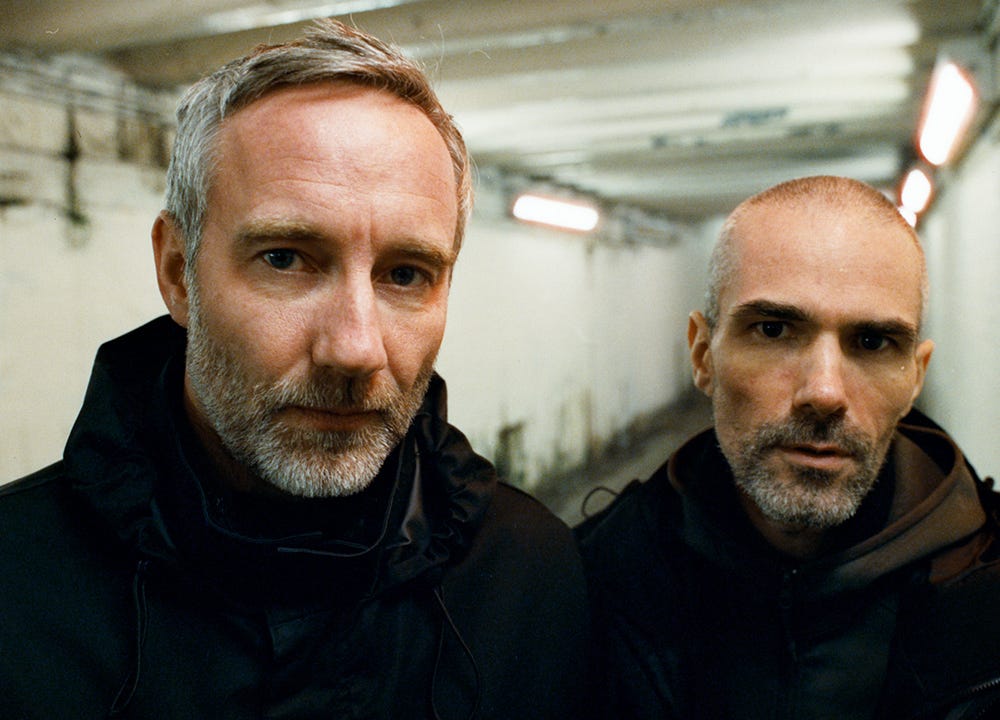
On every press image I’ve come across, Autechre are standing somewhere, in a tunnel or in front of a lake, wearing dark soft-shell outdoor coats and looking grim.
Back in the days, they were considered one of IDM’s ‘big three’.
While Boards Of Canada were tight-lipped, elusive prodigies from the Scottish highlands, and Aphex Twin positioned himself as the techno trickster, the Cornish conman, Autechre never created a marketable image based on their personalities.
With them, it’s all about the music. It either speaks to you or it doesn’t. There’s not much in between.
Where do I stand? Well, let’s just say that reading through 70-page transcripts of their Reddit AMAs or putting together playlists of 12-hour webcasts are basically my idea of a great Sunday afternoon.
In March 2020, when the first lockdowns hit, Autechre started transmitting daily on the audio broadcast platform Mixlr. Whenever I received a notification that they were going live, I dropped everything to tune in.
For hours, they played old-school hip-hop and electrofunk, bleep techno and acid house, British industrial and Belgian EBM, weird early German electronic music and rare Depeche Mode B-side remixes, Madlib beats and Griselda tunes, On-U Sound dubs and so much more.
These sets felt like hanging out at a friend’s house, going through their record collection while afternoons turn into evenings and, eventually, into late nights.
Autechre’s music tastes were shaped by growing up in 1980s Rochdale, a town in Greater Manchester. Though Rob Brown and Sean Booth have been creating electronic music for over 30 years, they’re not exactly clubgoers. I’ve heard them say they stopped going out in ‘91 or ‘92. They met through writing graffiti.
Judging from their interviews, they seem to be heavy introverts, and Sean has also publicly spoken about his neurodivergence, having been diagnosed with high-functioning autism – not as a child, but much later in life. (Oh, hello.)
For that reason, Sean struggles with music that feels too rigidly structured. I am the same; music that manages to deeply engage me usually has an element of unpredictability that others might perceive as randomness. That’s why I love free jazz, noise, musique concrète, and Autechre – and others don’t.
Others might consider their music inaccessible. It’s true to an extent. It surely isn’t easy to love. It’s more art than entertainment, and it can be quite challenging.
There’s nothing to ‘understand’ here though, as the music isn’t ‘about’ anything except the music itself. It’s like a Rothko painting or a Dondi whole-car.
The size of their discography might feel intimidating as well. The good news is that I really don’t think there is a bad Autechre album.
I often randomly decide to revisit one of their older records, and that one album I never dug too much will suddenly become the greatest thing on earth.
Autechre’s oeuvre of 30+ years can roughly be divided into four or five phases.
Signed to the influential Warp label after independently releasing some material under the name Lego Feet, Autechre started out with a relatively straight version of that era’s ambient techno. They’ve provided the 1992 Conceptual Mix, a five-and-a-half-hour DJ set showcasing the musical environment their early work was inspired by.
On their first two albums Incunabula (1993) and Amber (1994), they combined crunchy drum machine beats with lush synth pads and strong influences from acid and electro. You can already hear their genius at play here – Amber clearly ranks among the best atmospheric techno albums ever produced, on a level with Aphex Twin’s Selected Ambient Works 85-92 and pivotal early 1990s albums from The Orb, LFO, 808 State and Orbital.
By Tri Repetae (1995), Autechre had shaken off any similarities to their peers and developed an instantly recognizable, abstract machine funk. The music was still based on quantized beats, loops and samples. There are many legends about their creative process though – like the tale that they fed text files into their digital work stations and transformed them into sound.
It’s true that starting with Confield (2001), they shed most basic rules of harmony, melody and rhythm. Their sound now grew closer to electroacoustic music and musique concrète, like Xenakis or some GRM stuff, though they’ve usually denied or played down such high-brow influences.
In their own view, they were making glitchy techno tunes with a touch of sound art, which came from listening to experimental industrial groups like Coil, The Hafler Trio or Zoviet France.
Around the turn of the millennium, Autechre abandoned the loop approach and started feeding signals and samples into a custom-built chain of generative processes and hardware units, based on the programming language Max.
They’re referring to it as ‘the system’. Whenever they talk about it, it gets a bit esoteric. But that ‘system’ became increasingly complex throughout the years.
Autechre haven’t lived in the same city for many years. Sean moved to the British countryside, then back to Manchester, and then to Norway, while Rob lived in London for a long time. They mirrored their home studio setups, and have been sending tracks back and forth to work on each other’s ideas ever since.
An element that is defining their sound is that they’ve completely strayed away from all organic sound sources. Their instrument is the computer – they make all of their music exclusively on software and hardware. Even if they used samples of actual analog instruments, they’d edit and treat them until their origins could not be traced back by the listener.
By the end of the 2000s, they essentially turned into an improvising group, in the studio as well as on stage. I’ve read someone calling them an ‘electronic jam band’ recently, which I found quite apt. Indebted to that approach, they’ve been moving away from the single album format and putting out rather enormous bodies of work in the last decade.
The running time of their releases went from two hours (Exai, 2013) to four hours (Elseq, 2016) to eight hours (NTS Sessions, 2018). As if that wasn’t enough material to sift through, they released more than 50 full live show recordings since 2016.
With no shortage of Autechre material to listen to, I was still one of the thousands of nerds all around the world sitting in front of my computer on October 8, 2020, listening to the first livestream of SIGN, their first ‘short’ album in a decade, on the band website.
On this new and unexpectedly concise record, they went in a different direction than on their sprawling previous projects and created a broken but weirdly melodic post-ambient sound – which would have a lasting impact on the leftfield electronic music scene in the following years.
SIGN sounded deeply sad and melancholic and totally life-affirming at the same time. I was stunned by its austere beauty.
Two weeks later, they dropped a sister record: PLUS. They’ve been following this practice for decades – to release an album, then push out one or two EPs with material that, for various reasons, didn’t make the album. (Sean has said it might have been better to edit PLUS down to an EP.)
Since October 2020, Autechre haven’t released any new music, except for the odd remix and many more live recordings, which seems to be their main focus in recent years. What’s interesting is that they’re usually playing in complete darkness, to make you focus on what you’re hearing, not what you’re seeing. It’s just two dudes pushing buttons anyway.
Luckily, there’s still enough to discover in their back catalogue. Whenever I feel I want to hear something ‘new’ from Autechre, I just go back to a record I haven’t listened to in a while. It usually sounds completely different from how I remembered it.
Autechre for Dummies
Below you will find a one-week plan for a beginner’s journey into Autechre’s work, requiring around one hour of dedicated, focused listening per day.
Be warned though – discovering this music requires some commitment. If you don’t want to invest hours and hours of deep listening, don’t even bother. This music is clearly not for everyone, and especially not for casual listeners.
Day 1: Start with SIGN (2020). This is some proper moody synth ambient. Though it’s not some bland wallpaper music, it’s easy to fall in love with and a great gateway into their idiosyncratic sound world.
Day 2: Move on to Oversteps (2010) – this is one of Autechre’s best and also most bright and accessible records. We’re still taking it easy here, but this is already leading deeper into the current iteration of ‘the system’.
Day 3: Study their classic LP5 (1998), probably the defining Autechre album. I don’t recommend starting here right away though, as it can feel quite disorienting without any type of context. Believe me, I’ve been there.
Day 4: Explore the group’s ambient techno roots in Amber (1994), with its floating, dreamy synth pads and relatively straight rhythms. Make sure to add the Anti EP (1994) to your listening curriculum, especially “Flutter” with its ten minutes of strictly non-repetitive programmed beats.
Day 5: Move forward to Quaristice (2008), the album that birthed their improvising ‘jam band’ approach to electronic music. This basically explains most of the stuff they released afterwards, including the sprawling NTS Sessions and the Elseq series, as well as their live recordings.
Day 6: Spend a calm, focused morning with Confield (2001), maybe their most inaccessible, atonal record, and top it off with the Gantz Graf EP (2002). This doesn’t even bear any of the standard hallmarks of what we think of as music – the machines started to make sounds by and for themselves. Admittedly, you need to be wired a certain way to enjoy this.
Day 7: Congratulations, you’ve cracked the Autechre code! Now that you’ve explored the different lanes they went down during their 35-year career, feel free to dig into anything from their catalogue. You’ve barely even listened to half of their albums, and you still have to discover treats like Tri Repetae (1995), Draft 7.30 (2003) or Exai (2013). Some of my favorite tracks are buried deep on their post-album EPs, or in the hours of material released in the latter half of the 2010s. Have fun!


Love the Rothko comparison. I have always thought of them as the musical Cy Twombly. Impossible to understand at a glance, but with time meaning and form emerges. Their work has so much longevity as it demands relistening. Loving reading your Substack Stephan.
Thank you for this great, in-depth article about Autechre! Anti, Garbage, and Envane are my all-time favorite Autechre releases, probably because I grew up with them. I discovered Warp Records at the local record store. Ventolin by Aphex Twin was my first exposure to the label. Autechre, Squarepusher, LFO, µ-Ziq, BoC, among others, followed naturally. We were craving new releases from Warp, so it kind of became a Selbstläufer. It’s great too see that these artists are still putting out music and constantly reinventing their sound, and still stayed true to their roots.